The African Zebra Thesis: DAZZLE Them
Africa doesn't need more unicorns. It needs zebras — real, resilient, running together. The African Zebra Thesis proposes herd economics for sustainable venture growth.

Phin Mpofu-Masamba II
Founding Curator
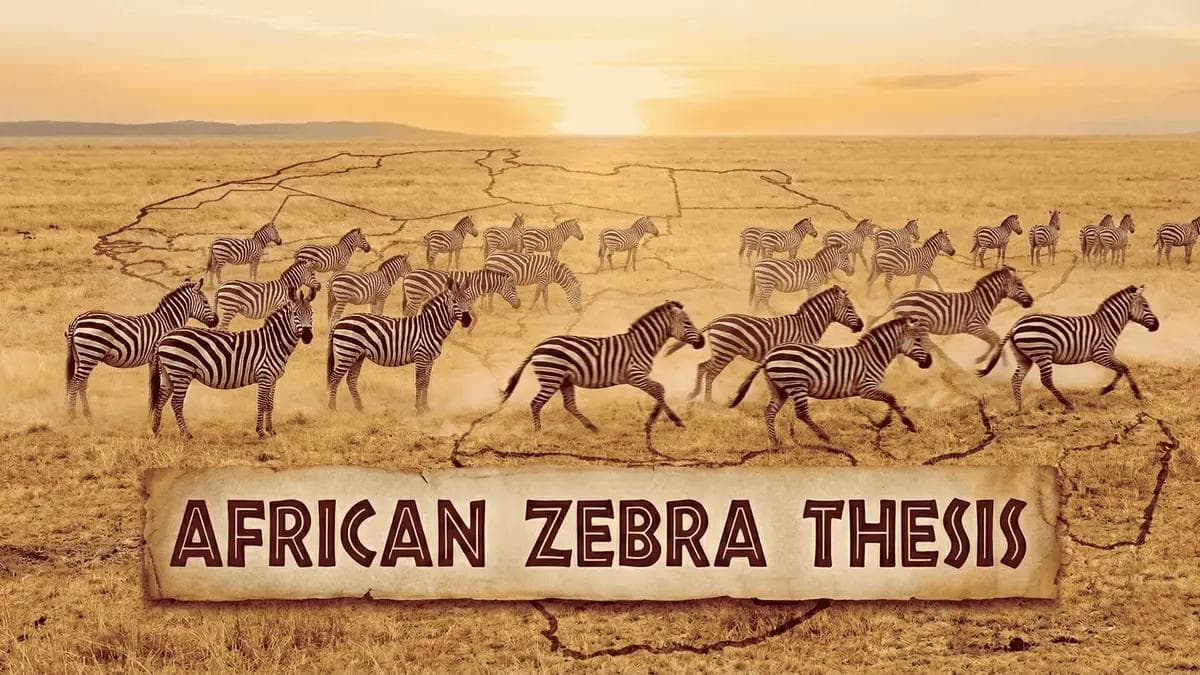
In 2017, Zebras Unite emerged from Silicon Valley with a manifesto: "Zebras Fix What Unicorns Break." It was a necessary corrective to the growth-at-all-costs culture that had come to define American venture capital. But here's the thing: zebras are not native to the Bay Area. They are native to the savannahs of Africa.
This is not merely adopting someone else's philosophy. This is reclaiming something indigenous to Africa.
The unicorn has become the totem of startup success globally. A mythical creature, rare by definition, solitary by nature, valued purely for its scarcity. Founders are told to chase unicorn status (the billion-dollar valuation) as though it were the only measure of success worth pursuing.
But unicorns are fictional. They do not exist. And the model they represent is failing African startups at an alarming rate.
The Unicorn Model Is Breaking Africa
The data is unambiguous.
Only 4.8% of African venture deals lead to successful exits. The exit-to-investment ratio sits at 0.13x, compared to 0.3x in more mature ecosystems. Between 2023 and 2024 alone, over $500 million was lost in high-profile startup failures across the continent. Jumia, once heralded as "Africa's Amazon" and the continent's first tech unicorn, has seen its stock collapse by 95%. A cautionary tale of what happens when African companies are forced to perform for Silicon Valley expectations rather than African realities.
The unicorn playbook optimises for explosive growth, rapid scaling, and spectacular exits. It assumes abundant capital, stable currencies, deep talent pools, and mature infrastructure. It assumes that speed is more important than sustainability.
Africa's context is different. Currency volatility can wipe out gains overnight. Infrastructure gaps mean building from first principles. Talent is abundant but often mobile, drawn to opportunities elsewhere. And capital, when it arrives, often comes with timelines and expectations misaligned with the pace at which African markets actually develop.
Africa does not need more unicorns. Africa needs zebras.
Why Zebras?
Zebras are real. They are resilient. And they are native to this continent.
The original Zebras Unite thesis proposed businesses that are both black and white: profitable AND purposeful. Not either/or, but both/and. Companies that repair rather than extract. That prioritise sustainable growth over unsustainable speed.
But there is another characteristic of zebras that matters even more for Africa: they run in herds. Or more precisely, they run in dazzles.
A dazzle is the collective noun for a group of zebras, and it is not merely poetic. When zebras move together, their stripes create a visual confusion that makes it nearly impossible for predators to isolate and attack a single animal. The collective protects the individual. Survival is a group activity.
This is the insight that African startup ecosystems need to internalise. The predators facing African founders (extractive capital, currency shocks, infrastructure deficits, market fragmentation) cannot be outrun by a single startup, no matter how fast it moves. But a dazzle? A coordinated group moving together, supporting each other, creating confusion for those who would pick them off one by one? That is a survival strategy.
The Herd Model Already Works
Silicon Valley, for all its unicorn obsession, actually understands herd dynamics better than it admits.
Consider Y Combinator. Twice a year, YC brings together a cohort of startups. These companies go through the programme together, demo together, and, crucially, often become each other's first customers. When a YC payments company needs a customer, another YC company signs up. When a YC infrastructure startup needs a reference client, they find one two desks away. Revenue circulates within the cohort before it leaks out to the broader market.
This is herd economics in action.
The Paystack acquisition is a perfect illustration. Paystack was a Y Combinator company. Stripe was a Y Combinator company. When Stripe acquired Paystack for over $200 million, it was the herd supporting its own. The model worked.
But it was Silicon Valley's herd capturing value from African innovation. The orchestration happened in San Francisco. The wealth creation flowed accordingly.
Africa needs its own orchestrator.
Dazzle Africa and the Connective Tissue for a Dazzle
This is where Dazzle Africa comes in.
Africa's innovation ecosystem already contains the raw materials for something extraordinary. Across 54 countries, thousands of startups, hubs, accelerators, universities and investors are operating, building, and growing. The talent exists. The ambition exists. The solutions exist. What has been missing is the visibility and deliberate orchestration that transforms a fragmented ecosystem into a herd, and a herd into a dazzle.
Dazzle Africa is being built to solve exactly that. A platform that tracks and maps the entire African startup ecosystem, making the invisible visible and the disconnected connected. Not a directory. Not a database. The connective tissue for startup transactions across the continent.
The opportunity is to move from a passive ecosystem to an active one. Three mechanisms drive this:
Orchestrated connections. When a mobility startup in Lagos needs payment processing, someone in the ecosystem has already built it. When a healthtech in Nairobi needs KYC verification, a fintech in Accra already offers it. Dazzle Africa's role is to see these complementarities and connect them. Deliberately, systematically, at scale. Revenue that would otherwise flow to external providers stays within the ecosystem.
Cohort-based commerce. Dazzle Africa surfaces fellow ecosystem members first when startups are procuring services. Not charity. Not forced purchasing. Simply a first-look framework that gives the herd an advantage. First customers. First revenue. First case studies. First references. The validation that makes external fundraising easier, generated internally.
Patient capital alignment. Not all capital is created equal. The zebra model requires investors who understand African timelines. Dazzle Africa maps the capital landscape too, connecting startups with revenue-based financing that aligns repayment with actual performance, strategic corporates seeking distribution rather than quick exits, and development finance institutions with longer horizons and tolerance for slower burns. The goal is capital that is compatible with sustainable growth, not capital that demands unsustainable speed.
What This Looks Like in Practice
Imagine a mobility startup based in Lagos. They need three things to operate: KYC verification for drivers, payment processing for rides, and insurance products for their fleet.
Under the unicorn model, they have two options. Build everything themselves, burning capital and time on problems already solved elsewhere. Or wait for sufficient funding to buy these services from established external providers, delaying launch and extending runway requirements.
Under the dazzle model, Dazzle Africa surfaces three startups already in the ecosystem. A fintech in Johannesburg handles KYC. A payments company in Nairobi processes transactions. An insurtech in Accra provides fleet coverage. All three gain a paying customer. The mobility startup launches faster with less capital. Revenue circulates within the ecosystem. Everyone's metrics improve. Everyone becomes more fundable.
The herd validates itself.
Customers Are the Best Capital
There is a phrase that needs to become central to African startup strategy: customers are the best capital.
Think about what revenue actually offers. No dilution. No board seats. No misaligned incentives. No currency risk if earned in the same market where it is spent. A startup with paying customers is infinitely more fundable than a startup with a pitch deck and a prayer.
The dazzle model prioritises revenue generation through internal ecosystem commerce. It does not reject external capital (growth often requires it) but it changes the sequencing. Revenue first. Validation first. Then capital, from a position of strength rather than desperation.
And when capital does arrive, it should be patient capital. Investors who understand that African markets develop on African timelines. Who measure success in revenue and sustainability, not just valuation and velocity. Who see dividends as acceptable returns, not signs of insufficient ambition.
This is not anti-venture capital. It is pro-appropriate capital.
Reclaiming the Metaphor
Zebras Unite did important work in articulating an alternative to unicorn culture. But the movement emerged from Silicon Valley, spoke primarily to American and European founders, and appears to have lost momentum. Their last public activity was in 2023.
Perhaps the metaphor needed to come home.
Zebras are African. The dazzle evolved on African savannahs as a response to African predators. The survival strategy of collective movement, of mutual protection, of endurance over speed: this is not a foreign philosophy being imported. It is indigenous wisdom waiting to be applied.
The African Zebra Thesis is not an adaptation. It is a reclamation.
An Invitation, Not a Prescription
I want to be clear about what this piece is and what it is not.
This is a thesis: a set of ideas I believe could be powerful for African venture growth. It is not a strategy. A strategy requires deep understanding of operational realities, existing constraints, and on-the-ground dynamics that I do not yet fully possess.
What I am offering is a provocation. A framework for thinking differently about how African startups grow, how they support each other, and how the existing infrastructure of networks like AfriLabs could be activated to drive collective success.
The questions I am sitting with:
- How do we operationalise herd economics without creating artificial markets or forced purchasing?
- What incentive structures encourage genuine intra-network commerce?
- How do we attract patient capital at scale?
- What metrics should we track to measure dazzle health, not just individual startup performance?
- How does this model interact with the realities of cross-border trade, currency differences, and regulatory fragmentation across 54 countries?
These are not rhetorical questions. They are genuine gaps in the thesis that require input from those closer to the ground.
Zebras Survive Together
The unicorn model asks founders to be exceptional individuals: singular, mythical, one in a billion. It is a lonely path with brutal odds.
The zebra model asks founders to be exceptional collaborators: real, resilient, running together. It is a collective path with better mathematics.
Africa does not need more solitary founders chasing mythical status. Africa needs dazzles: coordinated groups of sustainable businesses protecting each other from predators, generating revenue within the ecosystem, and building for endurance rather than exit.
The infrastructure exists. The network exists. The metaphor is ours.
Now we need the orchestration.
About the author
Phin Mpofu-Masamba II
Founding Curator
Phin Mpofu-Masamba II is the Founding Curator of Dazzle Africa and the author of The African Zebra Thesis, a framework for building a uniquely African startup-to-scaleup model. Born in Zimbabwe, he's spent 25+ years immersed in global startup ecosystems, including helping scale Startup Grind to over 600 chapters across 120 countries. He is also the founder of V.ONE, a boutique venture studio whose portfolio includes TRUVERI (the UK's definitive property transaction verification platform), Ugenie (next-gen social commerce and creator monetisation), and fanlens (football fan media hub). Recognised in the Maserati 100 and CMX Professional of the Year, Phin is based in Cheshire, England.